

What would happen if you heard the voice of God, but it came through a vessel you considered unworthy? Not merely unworthy, but vulgar, childish and offensively ordinary. Would you fall to your knees before the miracle or become the Devil to slit its throat until the voice gurgled and choked into bloody silence?
That is the dreadful question beating beneath Milos Forman’s Amadeus. The Director’s Cut makes the answer darker, crueller and more psychologically convincing. This is not really the story of Wolfgang Amadeus Mozart. It is the confession of Antonio Salieri: a respectable man who recognises the divine more clearly than anybody else and cannot forgive God for choosing someone else, somebody boorish, haphazard, anachronistic to embody the celestial choir here on earth.
We first encounter Salieri as an old man, having attempted suicide and announcing that he murdered Mozart.
F. Murray Abraham plays him like a Gothic relic, his face powdered into a death mask, his eyes gleaming with mischief, pain and theatrical self-loathing. He recounts his story to a bewildered priest, but this is not confession in any meaningful Christian sense.
Salieri is not seeking forgiveness. He wants an audience; the audience denied him in his prime when Mozart waltzed into Vienna and obliterated Salieri’s entire sense of self-worth.
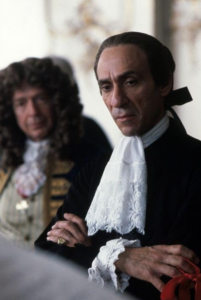
Abraham’s performance now looks like the template for Gary Oldman’s Count in Francis Ford Coppola’s Bram Stoker’s Dracula: the elaborate physical decay, the aristocratic cadence, the sudden flashes of childish pleasure, and the sense of an ancient sinner reliving his crimes with perverse relish.
Both performances move between grotesque comedy and infinite despair. Oldman’s Dracula challenges God over the death of his beloved. Salieri declares war upon Him because Mozart’s music reveals that he has never been loved by Him at all.
Salieri has lived prudently. He has denied himself sexual pleasure, devoted his talent to God and cultivated the dignified exterior of a great composer.
His reward is respectability, a place at the emperor’s side, and a cultured audience for his own operas.
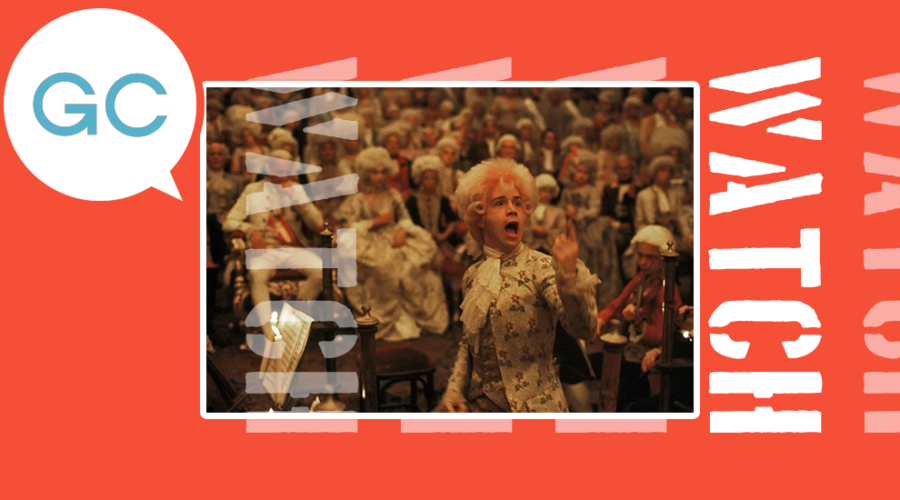
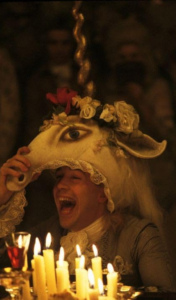
Then Mozart arrives, laughing like an embarrassed hyena, chasing women under tables and behaving as if good manners were an elaborate joke played upon the mediocre. He’s Johnny Rotten energizing the nation by swearing on the Bill Grundy show and being spat on by fans at the 100 Club.
Yet the music is perfect.
Tom Hulce’s Mozart possesses that post-punk sensibility. He does not reject classical music; he steals it away from its cultural gatekeepers, like Prometheus stealing fire from the gods. He wants to write opera in German, fill the stage with ordinary people and give the masses something immediate, funny, dangerous and alive.
The court worries about taste, tradition and the number of notes. Mozart wants to dazzle with a dozen or more voices harmonizing at once.
His shrieking laugh is therefore more than an eccentric affectation. It is an assault upon decorum. Mozart understands the absurdity of this world: the outrageous wigs for every occasion, the powdered faces and the bewigged officials solemnly deciding what art is permitted to become. He sees that civilisation is partly fancy dress and ridiculous behind the facade.
There is something of Terry Gilliam’s Time Bandits in Forman’s vision of Vienna. The costumes and palaces are magnificent, yet authority remains vain, confused and faintly preposterous. Jeffrey Jones’s Emperor Joseph II is forgiving yet pompous because his enormous power is combined with such limited understanding. His complaint that Mozart’s music contains ‘too many notes’ is bureaucracy’s response to transcendence: greatness must be reduced until it fits comfortably inside official taste.
The scene in which Salieri examines Mozart’s original manuscripts remains one of cinema’s greatest depictions of artistic revelation. There are no corrections. Mozart appears not to compose but to transcribe, as though the music has been divined directly from heaven above.
Where Wendy Torrence’s face realizes the abject madness in her husband’s prose in The Shining’s great reveal, Salieri alone understands the beautiful notes scribed before him.
The court see an irritating young man with questionable etiquette. Salieri hears God speaking.
Salieri’s tragedy is not that he is talentless. Salieri is only mediocre when measured against Mozart and mediocrity when measured against Mozart is no disgrace. He is successful, disciplined and capable of producing music that pleases audiences and emperors. Under any normal conditions, this would constitute an honourable life.
But Salieri possesses enough talent to recognise genius without possessing enough to equal it. That may be the most exquisite torture imaginable.
Someone with no musical understanding could dismiss Mozart. Salieri cannot. Every note confirms both his perceptiveness and his limitations. He is close enough to heaven to hear the angels singing but condemned to remain outside the gates.
Salieri possesses enough talent to recognise genius without possessing enough to equal it
From this humiliation come his Machiavellian moves against Mozart. Salieri never lunges like a conventional villain. He manoeuvres. He flatters, obstructs, manipulates appointments and disguises malice as friendship.
He rarely needs to lie outright because he has mastered the more civilised cruelty of arranging circumstances. He turns the protocols of court and patronage into weapons while maintaining the appearance of the concerned colleague.
The restored encounter with Constanze makes that cruelty more personal. Salieri humiliates her while pretending to help, corrupting hospitality, desire and professional influence at once. Elizabeth Berridge’s later contempt for him consequently has a necessary foundation. Salieri is no longer simply plotting against Mozart’s career. He is poisoning everything around him.
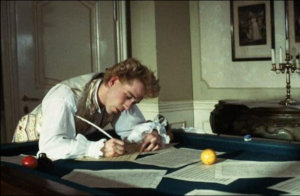 The final act turns musical creation into a form of possession. As the dying Mozart dictates the Requiem, Salieri finally enters the machinery of his genius. For a few feverish moments they become collaborators. Salieri struggles to keep pace while Mozart summons whole orchestral worlds from his bed. It is an act of exploitation, but also the closest Salieri will ever come to communion.
Mozart is buried in a common grave beneath grey skies. Salieri survives to become wealthy, celebrated and eventually forgotten, the self-appointed patron saint of mediocrities everywhere.
That final joke is his revenge upon us. Most viewers are not Mozart. We are Salieri, recognising beauty after somebody else has created it and wondering why the gift was withheld from us. Amadeus understands that envy is not simply wanting what another person possesses. It is the desire to destroy the evidence that they deserved it.
Salieri asks God for greatness and receives only the ability to recognise it. Feeling mocked, he embraces the role of God’s enemy. But the film’s cruellest insight is that he never truly becomes the Devil. He remains something far more familiar: an ordinary man who can hear heaven and cannot bear that it speaks in another (lesser bred) man’s voice.