

This month over at Five Books For, I’m looking at books that explore the Holocaust from different angles. As living memory recedes, I’ve been thinking about the particular value of literature in preserving not only what happened, but our capacity to imagine it. My grandparents belonged to a generation who could tell me about the Second World War because they had lived through it, but my son will never have that experience. For his generation, the war and the Holocaust will exist solely through history, testimony, museums, films and books.
That makes the ways in which we represent the Holocaust increasingly important. The books I have chosen this month deliberately approach it from different directions: through the intimate experience of a mother and child, through the perspectives of the perpetrators, through survival and the search for meaning, through memory and denial, and even through the speculative question of what the world might have looked like had the Nazis won.
However, here at Great Adaptations, I wanted to look at a book and film that take yet another approach – Martin Amis’s The Zone of Interest, and its remarkable film adaptation by Jonathan Glazer.
The book
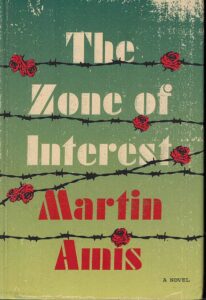 Amis’s The Zone of Interest, published in 2014, is an unusual Holocaust novel. Rather than concentrating on the victims, it takes us into the world of Auschwitz’s perpetrators. It is narrated by three men whose lives intersect within the camp: Paul Doll, its commandant; Golo Thomsen, an SS officer who becomes involved with Doll’s wife; and Szmul, a Jewish prisoner forced to work as a member of the Sonderkommando, disposing of the bodies of those who have been murdered.
One of Amis’s great strengths is his characterisation, particularly his refusal to give us easy answers about what his characters actually think.
Doll is the most grotesque of the three narrators, and his combination of vanity, incompetence and murderousness can make him seem almost absurd. But it is Thomsen, Hannah and Szmul who leave me with the more troubling questions. Hannah, Doll’s wife, is clearly repelled by her husband and by the life he represents, but is she repelled by what he does, or simply by the fact that she is married to him?
Her disgust is never quite enough to become moral opposition. Thomsen is equally elusive. He experiences the world with an almost sensual intensity – he notices women, clothes, food and physical beauty – yet he seems remarkably capable of existing alongside the machinery of extermination without allowing it to intrude upon his own consciousness. Is that indifference, self-deception, or something more complicated?
And then there is Szmul, perhaps the most difficult character of all. As a member of the Sonderkommando, he is forced to participate in the machinery that is destroying his own people. Amis gives us no comforting way to understand his position, and there isn’t one. How does a person continue to exist psychologically in circumstances in which every available choice is unbearable?
Szmul’s presence prevents the novel from becoming simply an examination of the perpetrators. He reminds us that the camp’s machinery was designed not only to kill, but to destroy the ordinary moral categories by which we understand human behaviour.
The result is a book in which almost every character leaves us with questions rather than answers – and those questions are much more disturbing than a straightforward portrait of good people and monsters would have been. It makes for a deeply uncomfortable book, but also one of the best books I’ve ever read.
Amis is clearly interested in the extraordinary capacity of people to continue behaving like ordinary people even in extraordinary (and extraordinarily evil) circumstances. His characters fall in love, worry about their jobs, argue with their spouses and fret about status while, literally next door, other human beings are being systematically murdered.
There is something almost grotesquely comic about the novel at times, which only serves to emphasise the horror. Amis writes beautifully and is a master at using language to expose the absurdity of the bureaucratic world in which mass murder has become a workplace problem – a matter of efficiency, targets and professional advancement.
It makes for a deeply uncomfortable book, but also one of the best books I’ve ever read.
The result is a novel about the banality of evil, but also about compartmentalisation: the perpetrators do not need to think of themselves as villains. They need only find ways of keeping the reality of what they are doing separate from the ordinary human lives they continue to lead.
It is this core idea that Jonathan Glazer takes from Amis and then transforms almost beyond recognition.
The film
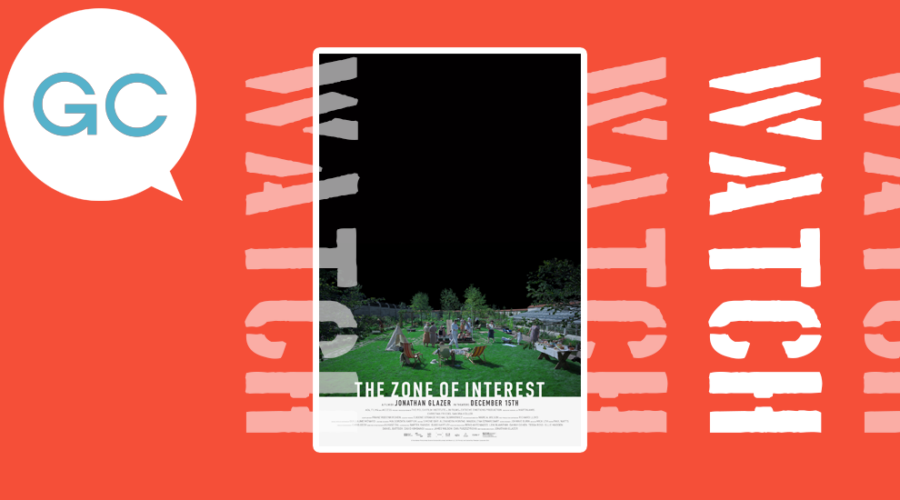
Glazer’s The Zone of Interest is not a faithful adaptation in the conventional sense. It is better described as a radical reinterpretation of the novel.
The film discards most of Amis’s plot and characters and instead concentrates almost entirely on Rudolf Höss, the real-life commandant of Auschwitz, his wife Hedwig and their children. Christian Friedel and Sandra Hüller play the couple brilliantly. Interestingly, Sandra Hüller had previously resolved not to play Nazi characters (a reluctance shared by Friedel), and when Jonathan Glazer offered her the role of Hedwig Höss, she initially declined.
What changed her mind was Glazer’s approach: rather than asking her to portray a conventional cinematic Nazi, he wanted to explore the unsettling ordinariness of a woman who had made a comfortable family life beside Auschwitz.
The difference between the book and the film is immediately apparent. At the most basic level, Amis takes us inside the camp, while Glazer keeps us resolutely outside the wall and firmly in the domestic sphere of the Höss family: Hedwig tends her garden. The children play. The family swims and eats together. There are conversations about holidays, possessions and household arrangements. Hedwig is particularly invested in the beautiful home she has created and is reluctant to leave it when Rudolf is transferred.
And all the while, the camp is there. We hear it almost constantly: gunshots, dogs, shouting, trains, machinery. Screams.
This extraordinary sound design means that Auschwitz is almost continuously present, without ever being explicitly shown. The Höss family have incorporated these sounds into the background of their lives; for the viewer, they become almost unbearable.
It’s a good example of Glazer’s trust in his audience, which we see again and again throughout the film, and the film is richer for it.
In some ways, the film is even more disturbing than the book. Amis makes us enter the minds of people participating in the machinery of murder; Glazer instead asks us to watch people who have made that machinery part of the scenery of their everyday lives.
The camp is everywhere, but the family has learned not to look
The garden is perhaps the clearest example. Hedwig’s flowers are beautiful, and she takes obvious pride in them. But the garden is separated from the camp by a wall, not by any meaningful moral boundary. At one point, ashes from the camp are mixed into the garden beds; for me at least, that particular scene provoked quite strong nausea. But Glazer never overexplains: he simply trusts the viewer to understand the context. I don’t think I’ve ever watched a film that does that quite so well, or to quite the same extent as this one.
As the film progresses, Glazer repeatedly finds ways for the Holocaust to leak into ordinary life without ever making it the centre of the frame. A pile of belongings arrives at the house. Hedwig tries on a fur coat taken from a murdered prisoner. Smoke rises in the distance. The children play games involving the things they hear. The camp is everywhere, but the family has learned not to look.
This is where the film’s title becomes particularly apt. The “zone of interest” is not merely the geographical area around Auschwitz. It is the psychological zone in which people can live alongside atrocity without allowing themselves to be troubled by it.
And then Glazer does something extraordinary at the end.
After spending almost the entire film refusing to show us the camp, he abruptly moves into the present day. We see cleaners working inside Auschwitz, maintaining the museum and its exhibits. We see the belongings of the people who were murdered: shoes, suitcases, crutches: ordinary objects, yet deeply personal. Mountains of them.
It is devastating.
For most of the film, we have been trapped inside the world of the perpetrators, seeing their house, their possessions and their garden. Suddenly we are confronted with the physical evidence of the people they murdered.
It creates the same effect that I found so powerful in Cynthia Ozick’s The Shawl: the zooming out from the individual, to the unimaginable scale of the Holocaust. Your heart breaks over one child; then you remember that millions of individual lives were taken.
In these final scenes, Glazer achieves something similar through the objects themselves. One pair of shoes belongs to one person. One suitcase belonged to one person. One pair of spectacles belonged to one person. And then you see thousands of them.
The final sequence also changes the meaning of the entire film. We have been watching people who are determined not to see. Now we are watching people whose work is, in part, to ensure that we do see.
An adaptation in spirit
For me, this is what makes The Zone of Interest such a fascinating adaptation. Glazer is profoundly unfaithful to the novel’s plot, characters and structure, but remarkably faithful to its central question.
Amis asks how people can live ordinary lives alongside extraordinary evil. The novelistic form dictates, to some extent, his approach, and it is a monumental achievement. Glazer is using a different language. Film cannot give us the same direct access to the inner thoughts of the characters, but it gives us visuals, and, crucially, sound. He turns the novel’s central question into a sensory experience.
These two pieces are both a contrast and yet also a perfect complement to each other: the book uses language, competing narrators and grotesque humour to expose the psychology of the perpetrators, while the film uses silence, sound, distance and repetition.
Amis takes us into the camp; Glazer keeps us outside the wall. Amis fictionalises the world of Auschwitz; Glazer brings real historical figures into focus.
Yet both arrive at the same disturbing conclusion: evil does not necessarily announce itself through monstrous behaviour. Sometimes it looks like a family dinner, a promotion, a beautiful garden or an argument about where to spend the summer.
That is perhaps why the film moved me so profoundly. Like the book, it refuses to keep the Holocaust safely in the past, as something done by people who were incomprehensibly different from ourselves. Instead, it asks us to look at the ordinary human mechanisms – self-interest, compartmentalisation, conformity and the desire for a comfortable life – that can exist alongside extraordinary cruelty.
The film is not simply an adaptation of Amis’s novel. It is an argument with it, a response to it and, in some ways, an extension of it. Perhaps that is what makes a great adaptation: not fidelity to the surface of a book, but fidelity to what lies beneath it.
Glazer does away with the idea of simply reproducing the novel. Instead, he understands what the book is really trying to say, and then finds a completely different language in which to say it.